> ## Documentation Index
> Fetch the complete documentation index at: https://docs.prefect.io/llms.txt
> Use this file to discover all available pages before exploring further.
# How to produce workflow artifacts
### Create link artifacts
To create a link artifact, use the `create_link_artifact()` function.
To create multiple versions of the same artifact and/or view them on the Artifacts page of the Prefect UI,
provide a `key` argument to the `create_link_artifact()` function to track the artifact's history over time.
Without a `key`, the artifact is only visible in the Artifacts tab of the associated flow run or task run.
```python theme={null}
from prefect import flow, task
from prefect.artifacts import create_link_artifact
@task
def my_first_task():
create_link_artifact(
key="irregular-data",
link="https://nyc3.digitaloceanspaces.com/my-bucket-name/highly_variable_data.csv",
description="## Highly variable data",
)
@task
def my_second_task():
create_link_artifact(
key="irregular-data",
link="https://nyc3.digitaloceanspaces.com/my-bucket-name/low_pred_data.csv",
description="# Low prediction accuracy",
)
@flow
def my_flow():
my_first_task()
my_second_task()
if __name__ == "__main__":
my_flow()
```
**Specify multiple artifacts with the same key for artifact lineage**
You can specify multiple artifacts with the same key to easily track something very specific, such as irregularities in your data pipeline.
After running flows that create artifacts, view the artifacts in the **Artifacts** page of the UI.
Click into the "irregular-data" artifact to see its versions, along with custom descriptions and links to the relevant data.
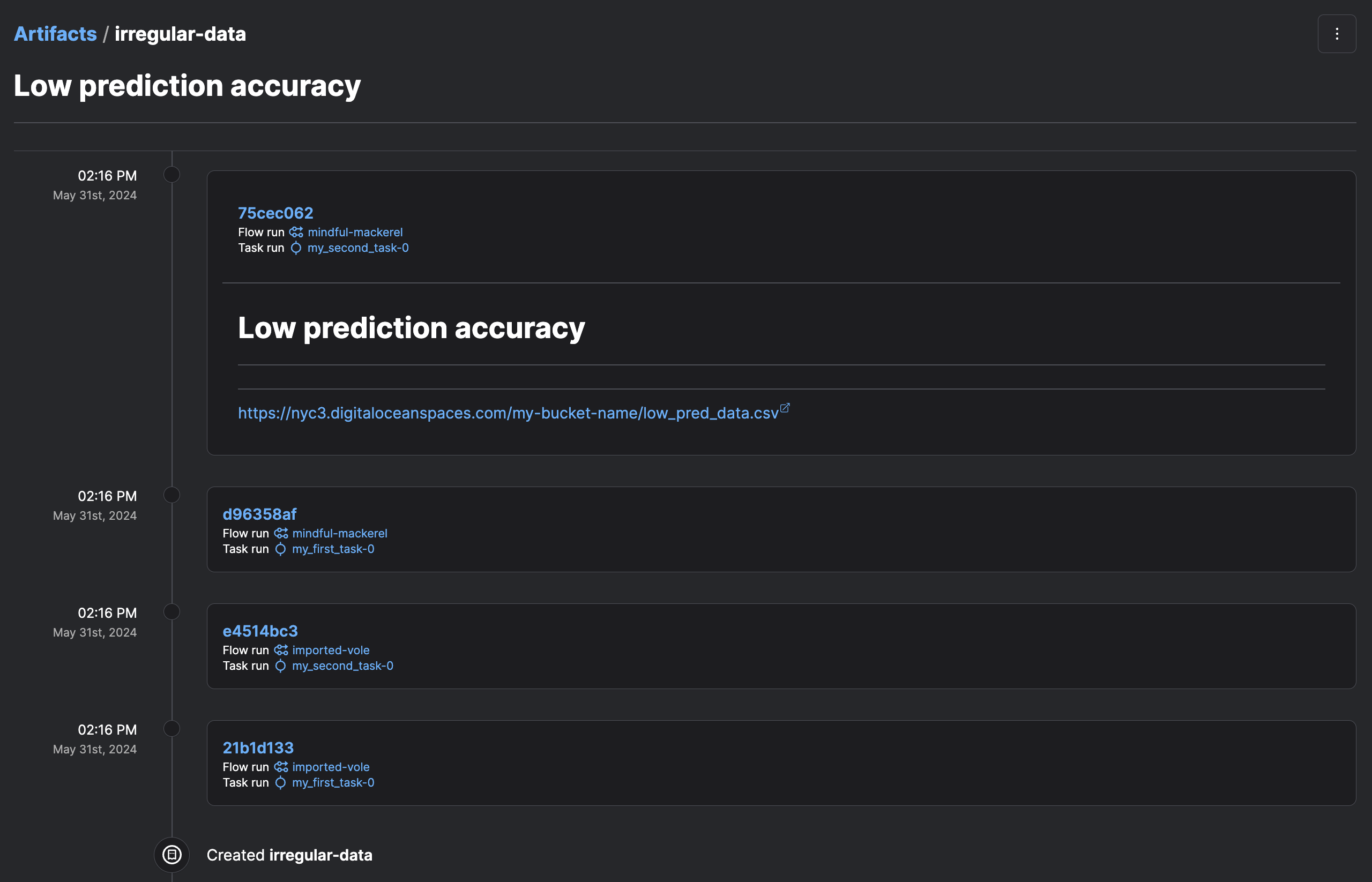 You can also view information about the artifact such as:
* its associated flow run or task run id
* previous and future versions of the artifact (multiple artifacts can have the same key to show lineage)
* data (in this case a Markdown-rendered link)
* an optional Markdown description
* when the artifact was created or updated
To make the links more readable for you and your collaborators, you can pass a `link_text` argument:
```python theme={null}
from prefect import flow
from prefect.artifacts import create_link_artifact
@flow
def my_flow():
create_link_artifact(
key="my-important-link",
link="https://www.prefect.io/",
link_text="Prefect",
)
if __name__ == "__main__":
my_flow()
```
In the above example, the `create_link_artifact` method is used within a flow to create a link artifact with a key of `my-important-link`.
The `link` parameter specifies the external resource to link to, and `link_text` specifies the text to display for the link.
Add an optional `description` for context.
### Create progress artifacts
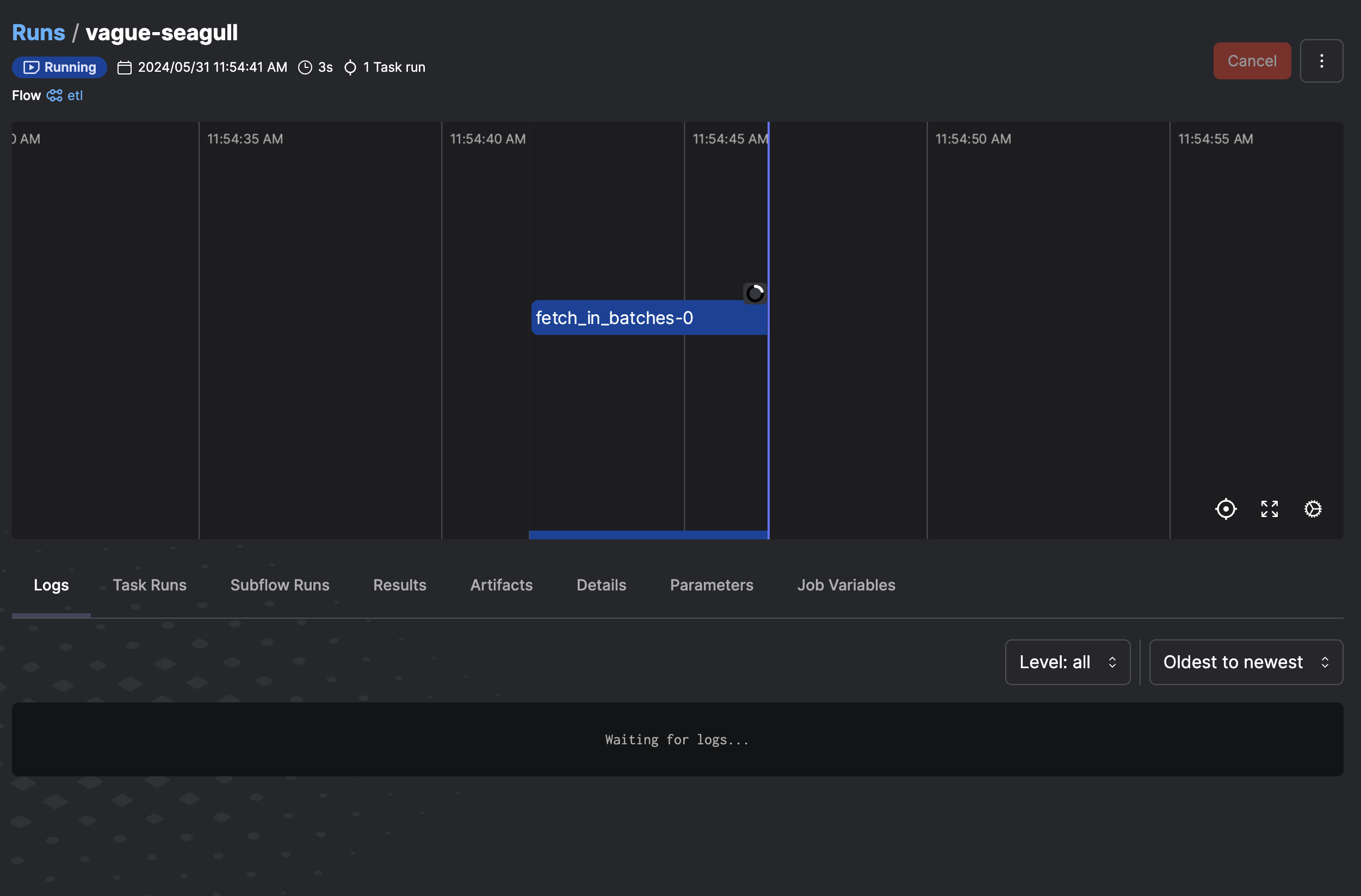
Progress artifacts render dynamically on the flow run graph in the Prefect UI, indicating the progress of long-running tasks.
To create a progress artifact, use the `create_progress_artifact()` function. To update a progress artifact, use the `update_progress_artifact()` function.
You can also view information about the artifact such as:
* its associated flow run or task run id
* previous and future versions of the artifact (multiple artifacts can have the same key to show lineage)
* data (in this case a Markdown-rendered link)
* an optional Markdown description
* when the artifact was created or updated
To make the links more readable for you and your collaborators, you can pass a `link_text` argument:
```python theme={null}
from prefect import flow
from prefect.artifacts import create_link_artifact
@flow
def my_flow():
create_link_artifact(
key="my-important-link",
link="https://www.prefect.io/",
link_text="Prefect",
)
if __name__ == "__main__":
my_flow()
```
In the above example, the `create_link_artifact` method is used within a flow to create a link artifact with a key of `my-important-link`.
The `link` parameter specifies the external resource to link to, and `link_text` specifies the text to display for the link.
Add an optional `description` for context.
### Create progress artifacts
Progress artifacts render dynamically on the flow run graph in the Prefect UI, indicating the progress of long-running tasks.
To create a progress artifact, use the `create_progress_artifact()` function. To update a progress artifact, use the `update_progress_artifact()` function.
 ```python theme={null}
from time import sleep
from prefect import flow, task
from prefect.artifacts import (
create_progress_artifact,
update_progress_artifact,
)
def fetch_batch(i: int):
# Simulate fetching a batch of data
sleep(2)
@task
def fetch_in_batches():
progress_artifact_id = create_progress_artifact(
progress=0.0,
description="Indicates the progress of fetching data in batches.",
)
for i in range(1, 11):
fetch_batch(i)
update_progress_artifact(artifact_id=progress_artifact_id, progress=i * 10)
@flow
def etl():
fetch_in_batches()
if __name__ == "__main__":
etl()
```
Progress artifacts are updated with the `update_progress_artifact()` function. Prefect updates a progress artifact in place, rather than versioning it.
### Create Markdown artifacts
To create a Markdown artifact, you can use the `create_markdown_artifact()` function.
To create multiple versions of the same artifact and/or view them on the Artifacts page of the Prefect UI, provide a `key` argument to the `create_markdown_artifact()` function to track an artifact's history over time.
Without a `key`, the artifact is only visible in the Artifacts tab of the associated flow run or task run.
**Don't indent Markdown**
Don't indent Markdown in multi-line strings. Otherwise it will be interpreted incorrectly.
```python theme={null}
from prefect import flow, task
from prefect.artifacts import create_markdown_artifact
@task
def markdown_task():
na_revenue = 500000
markdown_report = f"""# Sales Report
## Summary
In the past quarter, our company saw a significant increase in sales, with a total revenue of $1,000,000.
This represents a 20% increase over the same period last year.
## Sales by Region
| Region | Revenue |
|:--------------|-------:|
| North America | ${na_revenue:,} |
| Europe | $250,000 |
| Asia | $150,000 |
| South America | $75,000 |
| Africa | $25,000 |
## Top Products
1. Product A - $300,000 in revenue
2. Product B - $200,000 in revenue
3. Product C - $150,000 in revenue
## Conclusion
Overall, these results are very encouraging and demonstrate the success of our sales team in increasing revenue
across all regions. However, we still have room for improvement and should focus on further increasing sales in
the coming quarter.
"""
create_markdown_artifact(
key="gtm-report",
markdown=markdown_report,
description="Quarterly Sales Report",
)
@flow()
def my_flow():
markdown_task()
if __name__ == "__main__":
my_flow()
```
After running the above flow, you should see your "gtm-report" artifact in the Artifacts page of the UI.
```python theme={null}
from time import sleep
from prefect import flow, task
from prefect.artifacts import (
create_progress_artifact,
update_progress_artifact,
)
def fetch_batch(i: int):
# Simulate fetching a batch of data
sleep(2)
@task
def fetch_in_batches():
progress_artifact_id = create_progress_artifact(
progress=0.0,
description="Indicates the progress of fetching data in batches.",
)
for i in range(1, 11):
fetch_batch(i)
update_progress_artifact(artifact_id=progress_artifact_id, progress=i * 10)
@flow
def etl():
fetch_in_batches()
if __name__ == "__main__":
etl()
```
Progress artifacts are updated with the `update_progress_artifact()` function. Prefect updates a progress artifact in place, rather than versioning it.
### Create Markdown artifacts
To create a Markdown artifact, you can use the `create_markdown_artifact()` function.
To create multiple versions of the same artifact and/or view them on the Artifacts page of the Prefect UI, provide a `key` argument to the `create_markdown_artifact()` function to track an artifact's history over time.
Without a `key`, the artifact is only visible in the Artifacts tab of the associated flow run or task run.
**Don't indent Markdown**
Don't indent Markdown in multi-line strings. Otherwise it will be interpreted incorrectly.
```python theme={null}
from prefect import flow, task
from prefect.artifacts import create_markdown_artifact
@task
def markdown_task():
na_revenue = 500000
markdown_report = f"""# Sales Report
## Summary
In the past quarter, our company saw a significant increase in sales, with a total revenue of $1,000,000.
This represents a 20% increase over the same period last year.
## Sales by Region
| Region | Revenue |
|:--------------|-------:|
| North America | ${na_revenue:,} |
| Europe | $250,000 |
| Asia | $150,000 |
| South America | $75,000 |
| Africa | $25,000 |
## Top Products
1. Product A - $300,000 in revenue
2. Product B - $200,000 in revenue
3. Product C - $150,000 in revenue
## Conclusion
Overall, these results are very encouraging and demonstrate the success of our sales team in increasing revenue
across all regions. However, we still have room for improvement and should focus on further increasing sales in
the coming quarter.
"""
create_markdown_artifact(
key="gtm-report",
markdown=markdown_report,
description="Quarterly Sales Report",
)
@flow()
def my_flow():
markdown_task()
if __name__ == "__main__":
my_flow()
```
After running the above flow, you should see your "gtm-report" artifact in the Artifacts page of the UI.
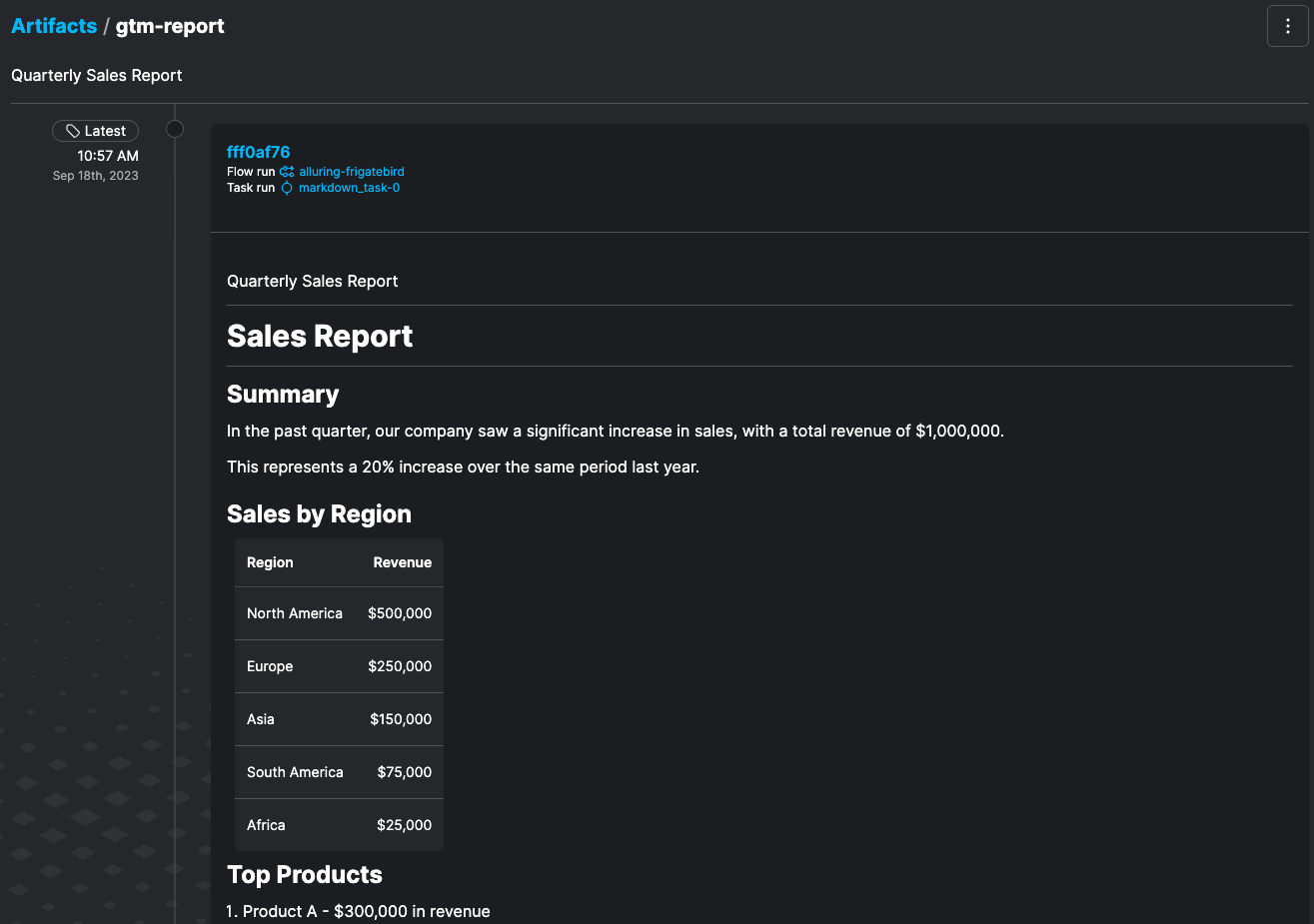 You can view the associated flow run id or task run id, previous versions of the artifact, the rendered Markdown data, and the optional Markdown description.
### Create table artifacts
Create a table artifact by calling `create_table_artifact()`.
To create multiple versions of the same artifact and/or view them on the Artifacts page of the Prefect UI, provide a `key` argument to the `create_table_artifact()` function to track an artifact's history over time.
Without a `key`, the artifact is only visible in the artifacts tab of the associated flow run or task run.
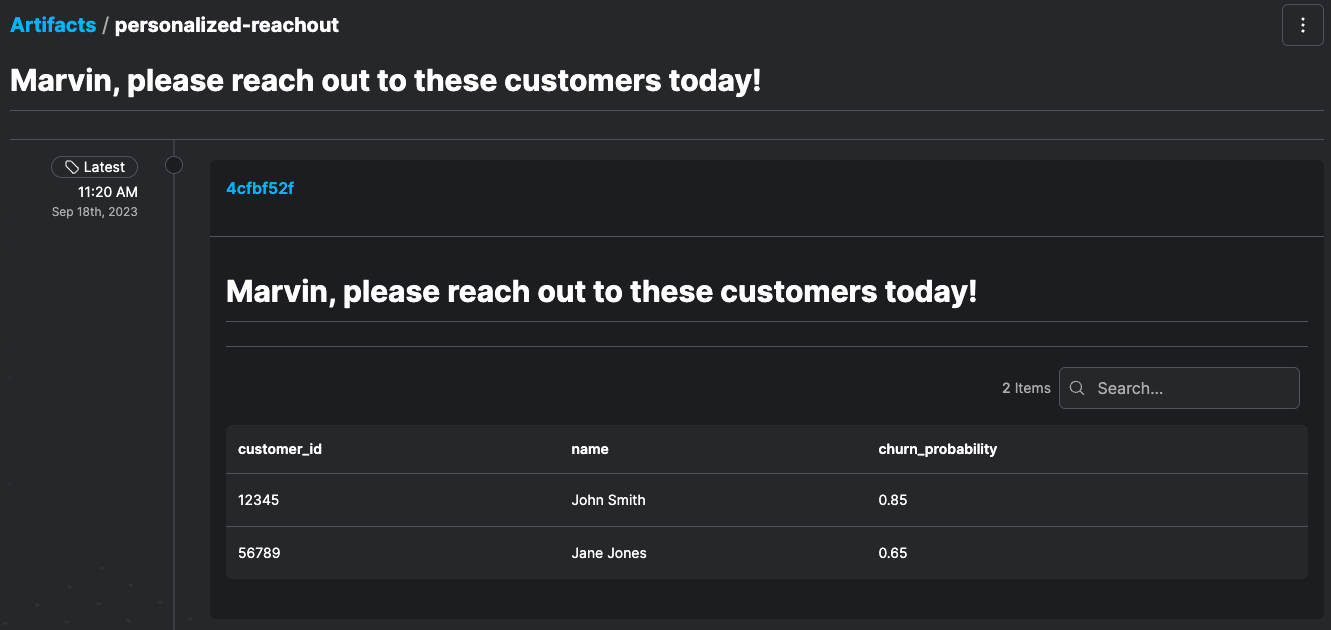
The `create_table_artifact()` function accepts a `table` argument. Pass this as a list of lists, a list of dictionaries, or a dictionary of lists.
```python theme={null}
from prefect.artifacts import create_table_artifact
def my_fn():
highest_churn_possibility = [
{'customer_id':'12345', 'name': 'John Smith', 'churn_probability': 0.85 },
{'customer_id':'56789', 'name': 'Jane Jones', 'churn_probability': 0.65 }
]
create_table_artifact(
key="personalized-reachout",
table=highest_churn_possibility,
description= "# Marvin, please reach out to these customers today!"
)
if __name__ == "__main__":
my_fn()
```
You can view the associated flow run id or task run id, previous versions of the artifact, the rendered Markdown data, and the optional Markdown description.
### Create table artifacts
Create a table artifact by calling `create_table_artifact()`.
To create multiple versions of the same artifact and/or view them on the Artifacts page of the Prefect UI, provide a `key` argument to the `create_table_artifact()` function to track an artifact's history over time.
Without a `key`, the artifact is only visible in the artifacts tab of the associated flow run or task run.
The `create_table_artifact()` function accepts a `table` argument. Pass this as a list of lists, a list of dictionaries, or a dictionary of lists.
```python theme={null}
from prefect.artifacts import create_table_artifact
def my_fn():
highest_churn_possibility = [
{'customer_id':'12345', 'name': 'John Smith', 'churn_probability': 0.85 },
{'customer_id':'56789', 'name': 'Jane Jones', 'churn_probability': 0.65 }
]
create_table_artifact(
key="personalized-reachout",
table=highest_churn_possibility,
description= "# Marvin, please reach out to these customers today!"
)
if __name__ == "__main__":
my_fn()
```
 ### Create image artifacts
Image artifacts render publicly available images in the Prefect UI. To create an image artifact, use the `create_image_artifact()` function.
### Create image artifacts
Image artifacts render publicly available images in the Prefect UI. To create an image artifact, use the `create_image_artifact()` function.
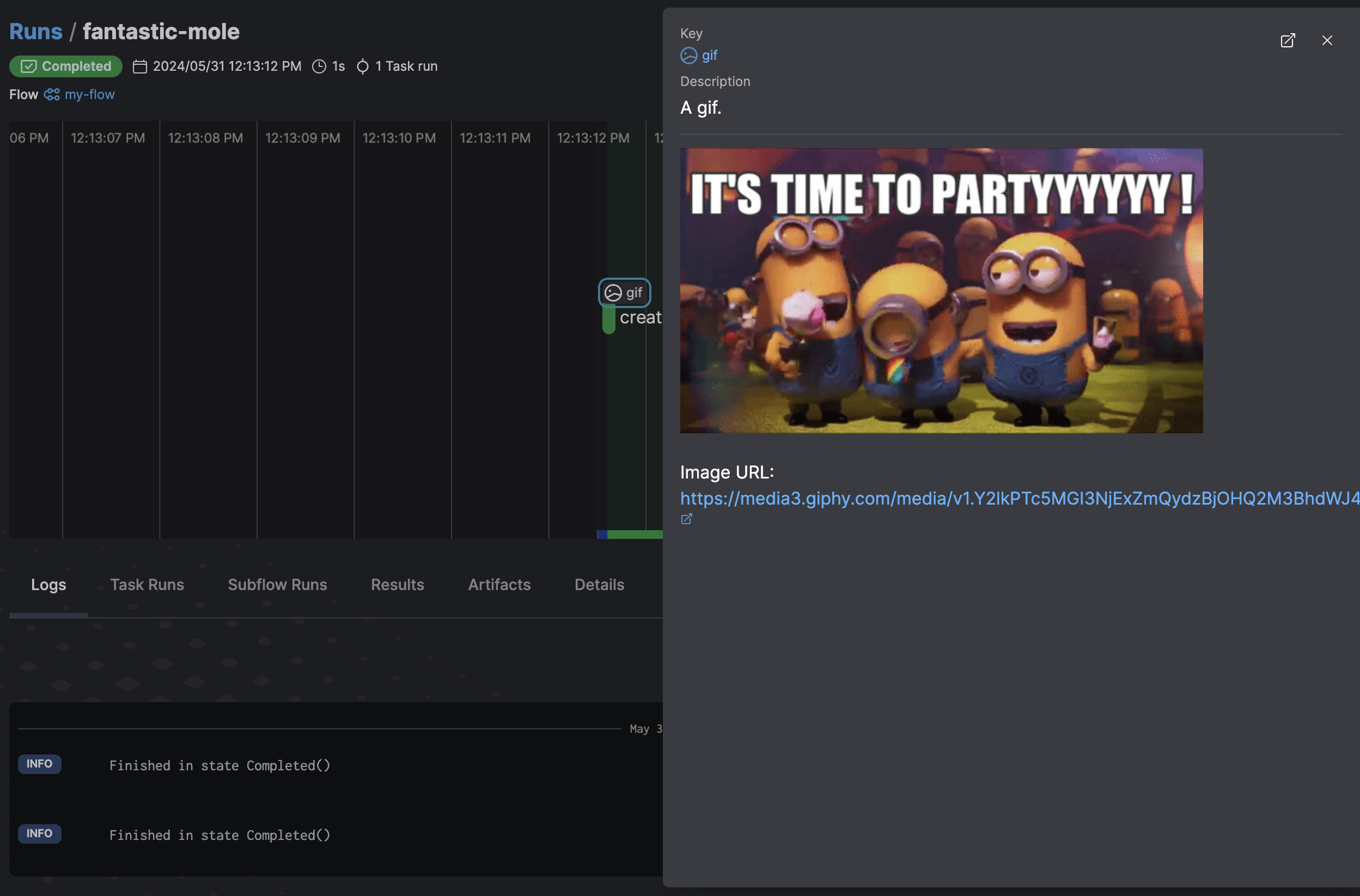 ```python theme={null}
from prefect import flow, task
from prefect.artifacts import (
create_image_artifact,
)
@task
def create_image():
# Do something to create an image and upload to a url
image_url = "https://media3.giphy.com/media/v1.Y2lkPTc5MGI3NjExZmQydzBjOHQ2M3BhdWJ4M3V1MGtoZGxuNmloeGh6b2dvaHhpaHg0eSZlcD12MV9pbnRlcm5hbF9naWZfYnlfaWQmY3Q9Zw/3KC2jD2QcBOSc/giphy.gif"
create_image_artifact(image_url=image_url, description="A gif.", key="gif")
return image_url
@flow
def my_flow():
return create_image()
if __name__ == "__main__":
image_url = my_flow()
print(f"Image URL: {image_url}")
```
To create an artifact that links to a private image, use the `create_link_artifact()` function instead.
### Reading artifacts
In the Prefect UI, you can view all of the latest versions of your artifacts and click into a specific artifact to see its lineage over time.
Additionally, you can inspect all versions of an artifact with a given key from the CLI by running:
```bash theme={null}
prefect artifact inspect
```
or view all artifacts by running:
```bash theme={null}
prefect artifact ls
```
You can also use the [Prefect REST API](https://app.prefect.cloud/api/docs#tag/Artifacts/operation/read_artifacts_api_accounts__account_id__workspaces__workspace_id__artifacts_filter_post)
to programmatically filter your results.
### Fetching artifacts
In Python code, you can retrieve an existing artifact with the `Artifact.get` class method:
```python theme={null}
from prefect.artifacts import Artifact
my_retrieved_artifact = Artifact.get("my_artifact_key")
```
### Delete artifacts
Delete an artifact in the CLI by providing a key or id:
```bash theme={null}
prefect artifact delete
```
```bash theme={null}
prefect artifact delete --id
```
```python theme={null}
from prefect import flow, task
from prefect.artifacts import (
create_image_artifact,
)
@task
def create_image():
# Do something to create an image and upload to a url
image_url = "https://media3.giphy.com/media/v1.Y2lkPTc5MGI3NjExZmQydzBjOHQ2M3BhdWJ4M3V1MGtoZGxuNmloeGh6b2dvaHhpaHg0eSZlcD12MV9pbnRlcm5hbF9naWZfYnlfaWQmY3Q9Zw/3KC2jD2QcBOSc/giphy.gif"
create_image_artifact(image_url=image_url, description="A gif.", key="gif")
return image_url
@flow
def my_flow():
return create_image()
if __name__ == "__main__":
image_url = my_flow()
print(f"Image URL: {image_url}")
```
To create an artifact that links to a private image, use the `create_link_artifact()` function instead.
### Reading artifacts
In the Prefect UI, you can view all of the latest versions of your artifacts and click into a specific artifact to see its lineage over time.
Additionally, you can inspect all versions of an artifact with a given key from the CLI by running:
```bash theme={null}
prefect artifact inspect
```
or view all artifacts by running:
```bash theme={null}
prefect artifact ls
```
You can also use the [Prefect REST API](https://app.prefect.cloud/api/docs#tag/Artifacts/operation/read_artifacts_api_accounts__account_id__workspaces__workspace_id__artifacts_filter_post)
to programmatically filter your results.
### Fetching artifacts
In Python code, you can retrieve an existing artifact with the `Artifact.get` class method:
```python theme={null}
from prefect.artifacts import Artifact
my_retrieved_artifact = Artifact.get("my_artifact_key")
```
### Delete artifacts
Delete an artifact in the CLI by providing a key or id:
```bash theme={null}
prefect artifact delete
```
```bash theme={null}
prefect artifact delete --id
```