> ## Documentation Index
> Fetch the complete documentation index at: https://docs.prefect.io/llms.txt
> Use this file to discover all available pages before exploring further.
# How to apply global concurrency and rate limits
> Learn how to control concurrency and apply rate limits using Prefect's provided utilities.
export const API = ({name, href}) => You can manage {name} with the Prefect API.
;
export const TF = ({name, href}) => You can manage {name} with the Terraform provider for Prefect.
;
export const global_concurrency = {
cli: "https://docs.prefect.io/v3/api-ref/cli/global-concurrency-limit",
api: "https://app.prefect.cloud/api/docs#tag/Concurrency-Limits-V2",
tf: "https://registry.terraform.io/providers/PrefectHQ/prefect/latest/docs/resources/global_concurrency_limit"
};
export const CLI = ({name, href}) => You can manage {name} with the Prefect CLI.
;
Use global concurrency limits to control how many operations run simultaneously, and rate limits to control how frequently operations can start. This guide shows you how to create, manage, and use these limits in your workflows.
For a deeper understanding of how global concurrency limits work and when to use them, see the [global concurrency limits concept page](/v3/concepts/global-concurrency-limits).
## Manage global concurrency and rate limits
You can create, read, edit, and delete concurrency limits through the Prefect UI, CLI, Python SDK, Terraform, or API.
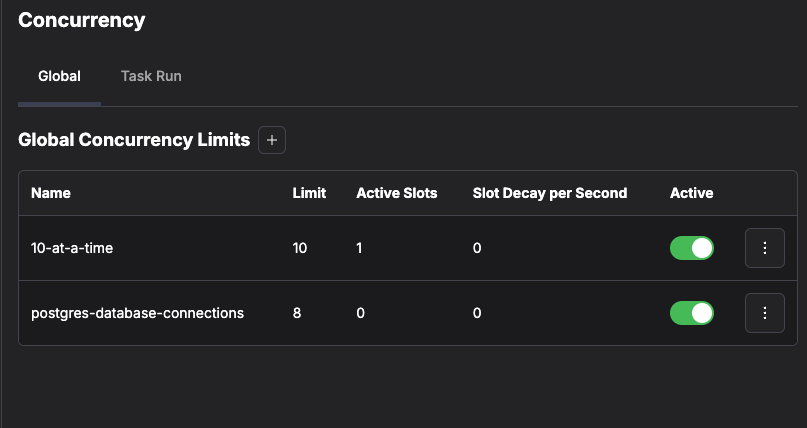
When creating a concurrency limit, you can specify:
* **Name**: How you'll reference the limit in your code (no special characters like `/`, `%`, `&`, `>`, `<`)
* **Concurrency Limit**: Maximum number of slots available
* **Slot Decay Per Second**: Rate at which slots are released (required for rate limiting)
* **Active**: Whether the limit is enforced (`true`) or disabled (`false`)
### Using the UI
Navigate to the **Concurrency** section in the Prefect UI to create, update, and delete concurrency limits.
 ### Using the CLI
Create a new concurrency limit with the `prefect gcl create` command:
```bash theme={null}
prefect gcl create my-concurrency-limit --limit 5 --slot-decay-per-second 1.0
```
Inspect a concurrency limit:
```bash theme={null}
prefect gcl inspect my-concurrency-limit
```
Update a concurrency limit:
```bash theme={null}
prefect gcl update my-concurrency-limit --limit 10
prefect gcl update my-concurrency-limit --disable
```
Delete a concurrency limit:
```bash theme={null}
prefect gcl delete my-concurrency-limit
Are you sure you want to delete global concurrency limit 'my-concurrency-limit'? [y/N]: y
Deleted global concurrency limit with name 'my-concurrency-limit'.
```
See all available commands and options with `prefect gcl --help`.
### Using Terraform
### Using the API
## Use the `concurrency` context manager
Control concurrent operations using the `concurrency` context manager. Choose the synchronous or asynchronous version based on your code.
By default, if a concurrency limit doesn't exist or lease renewal fails, a warning is logged but execution continues.
Use `strict=True` to raise an error instead. This ensures concurrency enforcement is guaranteed, useful for preventing resource exhaustion like database connection pool limits.
Use `raise_on_lease_renewal_failure=False` to allow long-running tasks to tolerate transient lease renewal errors even when `strict=True` is set.
### Synchronous usage
```python theme={null}
from prefect import flow, task
from prefect.concurrency.sync import concurrency
from prefect.futures import wait
@task
def process_data(x, y):
with concurrency("database", occupy=1):
return x + y
@flow
def my_flow():
futures = []
for x, y in [(1, 2), (2, 3), (3, 4), (4, 5)]:
futures.append(process_data.submit(x, y))
wait(futures)
if __name__ == "__main__":
my_flow()
```
### Asynchronous usage
```python theme={null}
import asyncio
from prefect import flow, task
from prefect.concurrency.asyncio import concurrency
from prefect.futures import wait
@task
async def process_data(x, y):
async with concurrency("database", occupy=1):
return x + y
@flow
def my_flow():
futures = []
for x, y in [(1, 2), (2, 3), (3, 4), (4, 5)]:
futures.append(process_data.submit(x, y))
wait(futures)
if __name__ == "__main__":
asyncio.run(my_flow())
```
In both examples, the `concurrency` context manager occupies one slot on the `database` concurrency limit. If no slots are available, execution blocks until a slot becomes available.
### Using strict mode
Enable strict mode to ensure errors are raised if the limit doesn't exist or if lease renewal fails:
```python theme={null}
from prefect import flow, task
from prefect.concurrency.sync import concurrency
@task
def process_critical_data(x, y):
# strict=True ensures this task fails fast if concurrency can't be enforced
with concurrency("database", occupy=1, strict=True):
return x + y
@flow
def critical_flow():
process_critical_data(1, 2)
```
Use `raise_on_lease_renewal_failure` to control lease renewal behavior independently of `strict`. For example, use `strict=True` to require the limit exists at acquisition time, while allowing long-running tasks to continue through transient renewal errors:
```python theme={null}
from prefect.concurrency.sync import concurrency
with concurrency("database", occupy=1, strict=True, raise_on_lease_renewal_failure=False):
# Slot acquisition requires the limit to exist (strict=True),
# but transient lease renewal failures won't terminate execution.
long_running_operation()
```
## Use `rate_limit`
Control the frequency of operations using the `rate_limit` function.
The concurrency limit must have `slot_decay_per_second` configured. Without it, `rate_limit` will fail.
### Synchronous usage
```python theme={null}
from prefect import flow, task
from prefect.concurrency.sync import rate_limit
@task
def make_http_request():
rate_limit("rate-limited-api")
print("Making an HTTP request...")
@flow
def my_flow():
for _ in range(10):
make_http_request.submit()
if __name__ == "__main__":
my_flow()
```
### Asynchronous usage
```python theme={null}
import asyncio
from prefect import flow, task
from prefect.concurrency.asyncio import rate_limit
@task
async def make_http_request():
await rate_limit("rate-limited-api")
print("Making an HTTP request...")
@flow
def my_flow():
for _ in range(10):
make_http_request.submit()
if __name__ == "__main__":
asyncio.run(my_flow())
```
The `rate_limit` function ensures requests are made at a controlled pace based on the concurrency limit's `slot_decay_per_second` setting.
## Use outside of flows
You can use `concurrency` and `rate_limit` in any Python code, not just within flows.
```python theme={null}
import asyncio
from prefect.concurrency.asyncio import rate_limit
async def main():
for _ in range(10):
await rate_limit("rate-limited-api")
print("Making an HTTP request...")
if __name__ == "__main__":
asyncio.run(main())
```
## Common patterns
### Throttle task submission
Prevent overwhelming downstream systems by controlling how quickly tasks are submitted:
```python theme={null}
from prefect import flow, task
from prefect.concurrency.sync import rate_limit
@task
def my_task(i):
return i
@flow
def my_flow():
for _ in range(100):
rate_limit("slow-my-flow", occupy=1)
my_task.submit(1)
if __name__ == "__main__":
my_flow()
```
### Limit database connections
Prevent exhausting your database connection pool by limiting concurrent queries:
```python theme={null}
from prefect import flow, task, concurrency
from myproject import db
@task
def database_query(query):
# Here we request a single slot on the 'database' concurrency limit. This
# will block in the case that all of the database connections are in use
# ensuring that we never exceed the maximum number of database connections.
with concurrency("database", occupy=1):
result = db.execute(query)
return result
@flow
def my_flow():
queries = ["SELECT * FROM table1", "SELECT * FROM table2", "SELECT * FROM table3"]
for query in queries:
database_query.submit(query)
if __name__ == "__main__":
my_flow()
```
### Control parallel processing
Process data in controlled batches to avoid resource exhaustion:
```python theme={null}
import asyncio
from prefect.concurrency.sync import concurrency
async def process_data(data):
print(f"Processing: {data}")
await asyncio.sleep(1)
return f"Processed: {data}"
async def main():
data_items = list(range(100))
processed_data = []
while data_items:
with concurrency("data-processing", occupy=5):
chunk = [data_items.pop() for _ in range(5)]
processed_data += await asyncio.gather(
*[process_data(item) for item in chunk]
)
print(processed_data)
if __name__ == "__main__":
asyncio.run(main())
```
## Next steps
For more information about how global concurrency limits work and when to use them versus other concurrency controls, see the [global concurrency limits concept page](/v3/concepts/global-concurrency-limits).
### Using the CLI
Create a new concurrency limit with the `prefect gcl create` command:
```bash theme={null}
prefect gcl create my-concurrency-limit --limit 5 --slot-decay-per-second 1.0
```
Inspect a concurrency limit:
```bash theme={null}
prefect gcl inspect my-concurrency-limit
```
Update a concurrency limit:
```bash theme={null}
prefect gcl update my-concurrency-limit --limit 10
prefect gcl update my-concurrency-limit --disable
```
Delete a concurrency limit:
```bash theme={null}
prefect gcl delete my-concurrency-limit
Are you sure you want to delete global concurrency limit 'my-concurrency-limit'? [y/N]: y
Deleted global concurrency limit with name 'my-concurrency-limit'.
```
See all available commands and options with `prefect gcl --help`.
### Using Terraform
### Using the API
## Use the `concurrency` context manager
Control concurrent operations using the `concurrency` context manager. Choose the synchronous or asynchronous version based on your code.
By default, if a concurrency limit doesn't exist or lease renewal fails, a warning is logged but execution continues.
Use `strict=True` to raise an error instead. This ensures concurrency enforcement is guaranteed, useful for preventing resource exhaustion like database connection pool limits.
Use `raise_on_lease_renewal_failure=False` to allow long-running tasks to tolerate transient lease renewal errors even when `strict=True` is set.
### Synchronous usage
```python theme={null}
from prefect import flow, task
from prefect.concurrency.sync import concurrency
from prefect.futures import wait
@task
def process_data(x, y):
with concurrency("database", occupy=1):
return x + y
@flow
def my_flow():
futures = []
for x, y in [(1, 2), (2, 3), (3, 4), (4, 5)]:
futures.append(process_data.submit(x, y))
wait(futures)
if __name__ == "__main__":
my_flow()
```
### Asynchronous usage
```python theme={null}
import asyncio
from prefect import flow, task
from prefect.concurrency.asyncio import concurrency
from prefect.futures import wait
@task
async def process_data(x, y):
async with concurrency("database", occupy=1):
return x + y
@flow
def my_flow():
futures = []
for x, y in [(1, 2), (2, 3), (3, 4), (4, 5)]:
futures.append(process_data.submit(x, y))
wait(futures)
if __name__ == "__main__":
asyncio.run(my_flow())
```
In both examples, the `concurrency` context manager occupies one slot on the `database` concurrency limit. If no slots are available, execution blocks until a slot becomes available.
### Using strict mode
Enable strict mode to ensure errors are raised if the limit doesn't exist or if lease renewal fails:
```python theme={null}
from prefect import flow, task
from prefect.concurrency.sync import concurrency
@task
def process_critical_data(x, y):
# strict=True ensures this task fails fast if concurrency can't be enforced
with concurrency("database", occupy=1, strict=True):
return x + y
@flow
def critical_flow():
process_critical_data(1, 2)
```
Use `raise_on_lease_renewal_failure` to control lease renewal behavior independently of `strict`. For example, use `strict=True` to require the limit exists at acquisition time, while allowing long-running tasks to continue through transient renewal errors:
```python theme={null}
from prefect.concurrency.sync import concurrency
with concurrency("database", occupy=1, strict=True, raise_on_lease_renewal_failure=False):
# Slot acquisition requires the limit to exist (strict=True),
# but transient lease renewal failures won't terminate execution.
long_running_operation()
```
## Use `rate_limit`
Control the frequency of operations using the `rate_limit` function.
The concurrency limit must have `slot_decay_per_second` configured. Without it, `rate_limit` will fail.
### Synchronous usage
```python theme={null}
from prefect import flow, task
from prefect.concurrency.sync import rate_limit
@task
def make_http_request():
rate_limit("rate-limited-api")
print("Making an HTTP request...")
@flow
def my_flow():
for _ in range(10):
make_http_request.submit()
if __name__ == "__main__":
my_flow()
```
### Asynchronous usage
```python theme={null}
import asyncio
from prefect import flow, task
from prefect.concurrency.asyncio import rate_limit
@task
async def make_http_request():
await rate_limit("rate-limited-api")
print("Making an HTTP request...")
@flow
def my_flow():
for _ in range(10):
make_http_request.submit()
if __name__ == "__main__":
asyncio.run(my_flow())
```
The `rate_limit` function ensures requests are made at a controlled pace based on the concurrency limit's `slot_decay_per_second` setting.
## Use outside of flows
You can use `concurrency` and `rate_limit` in any Python code, not just within flows.
```python theme={null}
import asyncio
from prefect.concurrency.asyncio import rate_limit
async def main():
for _ in range(10):
await rate_limit("rate-limited-api")
print("Making an HTTP request...")
if __name__ == "__main__":
asyncio.run(main())
```
## Common patterns
### Throttle task submission
Prevent overwhelming downstream systems by controlling how quickly tasks are submitted:
```python theme={null}
from prefect import flow, task
from prefect.concurrency.sync import rate_limit
@task
def my_task(i):
return i
@flow
def my_flow():
for _ in range(100):
rate_limit("slow-my-flow", occupy=1)
my_task.submit(1)
if __name__ == "__main__":
my_flow()
```
### Limit database connections
Prevent exhausting your database connection pool by limiting concurrent queries:
```python theme={null}
from prefect import flow, task, concurrency
from myproject import db
@task
def database_query(query):
# Here we request a single slot on the 'database' concurrency limit. This
# will block in the case that all of the database connections are in use
# ensuring that we never exceed the maximum number of database connections.
with concurrency("database", occupy=1):
result = db.execute(query)
return result
@flow
def my_flow():
queries = ["SELECT * FROM table1", "SELECT * FROM table2", "SELECT * FROM table3"]
for query in queries:
database_query.submit(query)
if __name__ == "__main__":
my_flow()
```
### Control parallel processing
Process data in controlled batches to avoid resource exhaustion:
```python theme={null}
import asyncio
from prefect.concurrency.sync import concurrency
async def process_data(data):
print(f"Processing: {data}")
await asyncio.sleep(1)
return f"Processed: {data}"
async def main():
data_items = list(range(100))
processed_data = []
while data_items:
with concurrency("data-processing", occupy=5):
chunk = [data_items.pop() for _ in range(5)]
processed_data += await asyncio.gather(
*[process_data(item) for item in chunk]
)
print(processed_data)
if __name__ == "__main__":
asyncio.run(main())
```
## Next steps
For more information about how global concurrency limits work and when to use them versus other concurrency controls, see the [global concurrency limits concept page](/v3/concepts/global-concurrency-limits).